


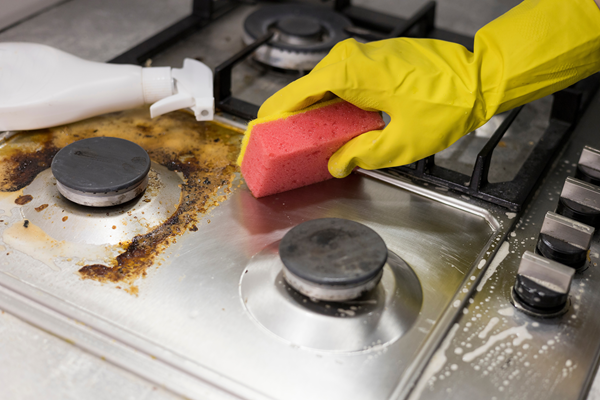
Spend enough time around a kitchen, and one thing becomes clear pretty quickly… grease does not stay where it started.
It begins on a stovetop or inside a pan, but it does not end there. It travels. It floats through the air, settles on surfaces, and builds up in places that are not always obvious. Cabinets, walls, appliances, even areas that do not seem connected to cooking at all… they all end up collecting some level of residue over time.
That is where things start to get tricky.
At first, grease buildup is barely noticeable. A surface might feel slightly sticky, or look a little dull compared to the day it was cleaned. Over time, that light layer turns into something thicker. It collects dust, holds onto particles, and becomes harder to remove with basic wiping.
At that point, regular cleaning products start to struggle.
Grease is not like dirt that lifts easily with water alone. It is made up of oils and fats, which means it needs something designed to break it down before it can be removed. Without that step, cleaning often just spreads it around instead of getting rid of it.
That is why degreasing is a big part of the process.
Degreasers are formulated to break apart those oil-based residues. Once the grease is loosened, it can actually be wiped away instead of smeared across the surface. Without that chemical step, the rest of the process does not go very far.
Temperature plays a role too.
Warm water helps soften grease and makes it easier to work with. Cold water tends to leave it intact, which is why certain surfaces still feel greasy even after being cleaned. Adding heat to the process helps reduce that resistance and allows the cleaning solution to do its job.
Then comes the physical side of things.
Even after grease is broken down, it still needs to be removed. That means scrubbing, wiping, and sometimes repeating the process more than once. Some surfaces hold onto residue more than others, especially if buildup has been there for a while.
Patience becomes part of the job.
Different materials respond differently as well.
Stainless steel, for example, tends to show grease quickly but can also be cleaned effectively with the right approach. Wood surfaces require more care, since harsh chemicals can damage the finish. Tile and grout can trap grease in small spaces, which makes removal a little more involved.
There is no single method that works for everything.
Ventilation systems are one of the most overlooked areas when it comes to grease.
Cooking releases particles into the air, and those particles get pulled into vents and hoods. Over time, grease builds up inside those systems. It is not something that is seen every day, but it is there, and it affects how the system works.
Left alone long enough, it can also become a larger issue.
Floors are another place where grease quietly builds up.
It usually starts near cooking areas, then spreads outward. At first, it may not be noticeable, but eventually it changes how the surface feels. It can become slick, which introduces a safety concern on top of the cleaning issue.
Addressing that buildup requires the same combination of breakdown and removal.
One of the biggest challenges with grease is how it hides.
Behind appliances, along edges, under equipment… those areas do not get cleaned as often, which makes them the perfect place for buildup to develop. By the time it is discovered, it is usually more than a light layer.
Getting to those spots takes intention.
Consistency is what keeps everything manageable.
When grease is addressed regularly, it does not have time to build into something more difficult. Surfaces stay easier to clean, and the overall environment stays more controlled. Waiting too long between cleanings allows layers to develop, which increases the effort needed later.
It becomes a cycle.
Another factor that often gets overlooked is how grease affects more than just appearance.
Residue can hold onto odors, affect air quality, and create conditions where bacteria can develop. Removing grease is not just about how a kitchen looks… it is about how it functions overall.
The process itself is not complicated, but it does require the right approach.
Breaking down the grease, using the right temperature, applying physical effort, and paying attention to hidden areas… all of it works together. Skip one step, and the results are not the same.
That is usually when surfaces start feeling like they were cleaned… but not really clean.
Kitchen environments are active by nature.
Cooking continues, grease continues to be produced, and surfaces continue to collect residue. That part does not change. What does change is how that buildup is handled over time.
Stay ahead of it, and it remains manageable.
Let it build, and it turns into something that takes a lot more effort to remove.
Either way, grease is going to show up.
The difference comes down to what happens next.

